Warm Water and the Anxious Mind: The Neurochemical Case for Thermal Bathing Your Doctor Probably Hasn't Mentioned
A Disclaimer Worth Reading First
Before we go any further: this article is not telling you to stop taking your medication. That's a conversation for you and your doctor, full stop. What this is — is an honest look at research that deserves way more airtime than it's getting, and a conversation about why water-based therapy and conventional psychiatric treatment shouldn't be treated as mutually exclusive.
Okay. Now let's talk about what warm water actually does to an anxious brain.
The Scale of the Problem
Anxiety disorders affect roughly 40 million adults in the United States — about 18% of the population — making them the most common mental health condition in the country. Selective serotonin reuptake inhibitors (SSRIs) are the most frequently prescribed treatment, and for many people, they're genuinely helpful. But they also come with a well-documented list of side effects: sexual dysfunction, weight changes, emotional blunting, and discontinuation syndrome that can make stopping them a project in itself.
About a third of people with anxiety disorders don't respond adequately to first-line medications. Another significant chunk respond partially — the anxiety is reduced but not gone, the side effects are tolerable but present. For this population especially, the question of what else exists is not just academic. It's urgent.
What Happens in Your Nervous System When You Submerge
Warm water immersion — we're talking about full-body submersion in water between 92°F and 100°F — triggers a cascade of neurological events that are, frankly, impressive in their scope.
The first thing that happens is a shift in your autonomic nervous system. The warm water activates thermoreceptors in the skin, which send signals to the hypothalamus. The result is a measurable reduction in sympathetic nervous system activity — the "fight or flight" system — and a corresponding increase in parasympathetic tone. In plain terms: your nervous system stops bracing for impact.
Cortisol, the primary stress hormone, drops. A 2018 study published in Evidence-Based Complementary and Alternative Medicine found that a single 20-minute warm water immersion session reduced salivary cortisol levels by an average of 22% in participants with elevated baseline stress. That's not a trivial number.
The Vagus Nerve Connection
Here's where it gets really interesting for anyone who's been following the somatic therapy conversation. The vagus nerve — the longest cranial nerve in the body, running from your brainstem through your heart and gut — is increasingly recognized as a central player in anxiety regulation. "Vagal tone," a measure of how well this nerve is functioning, is directly correlated with anxiety levels, emotional resilience, and even social connection.
Warm water immersion has been shown to stimulate vagal activity in multiple ways. The hydrostatic pressure of water on the chest and abdomen — even at relatively shallow depths — gently compresses the thoracic cavity and stimulates baroreceptors that feed directly into vagal pathways. The warmth itself promotes vasodilation that reduces blood pressure, which the vagus nerve interprets as a safety signal.
This is why people don't just feel relaxed after a thermal bath — they often describe feeling safe in a way that's qualitatively different from the relaxation produced by, say, a glass of wine or a Netflix binge. The nervous system isn't just distracted. It's actually recalibrated.
Endorphins, Serotonin, and the Feel-Good Chemistry of Water
Warm water immersion also triggers endorphin release — the same neurochemical pathway activated by exercise and laughter. But it goes further. Research from the Thrombosis Research Institute in London found that regular cold-to-warm water transitions (a staple of Bulgarian hydrotherapy protocols) measurably increase serotonin production over time, not just in the moment.
This is significant because SSRIs work by making existing serotonin more available — they don't increase production. Thermal bathing, particularly when practiced consistently, may actually support the upstream process of serotonin synthesis. These mechanisms aren't in competition. They're potentially complementary.
Real People, Real Shifts
Mark, a 38-year-old software engineer from Austin, had been on SSRIs for four years when he first visited a Bulgarian thermal spa during a work trip to Sofia. "I wasn't there for wellness reasons — honestly, a colleague dragged me," he says. "But after three days of daily soaks, I slept better than I had in years. I came home and started looking into what had actually happened."
He eventually connected with a somatic therapist stateside and began a protocol of weekly warm water immersion combined with breathwork. Over eighteen months, in close coordination with his psychiatrist, he reduced his SSRI dose by half. "I'm not anti-medication," he's careful to say. "It helped me when I needed it. But I feel like I found something that addresses the root of how my nervous system works, not just the symptoms."
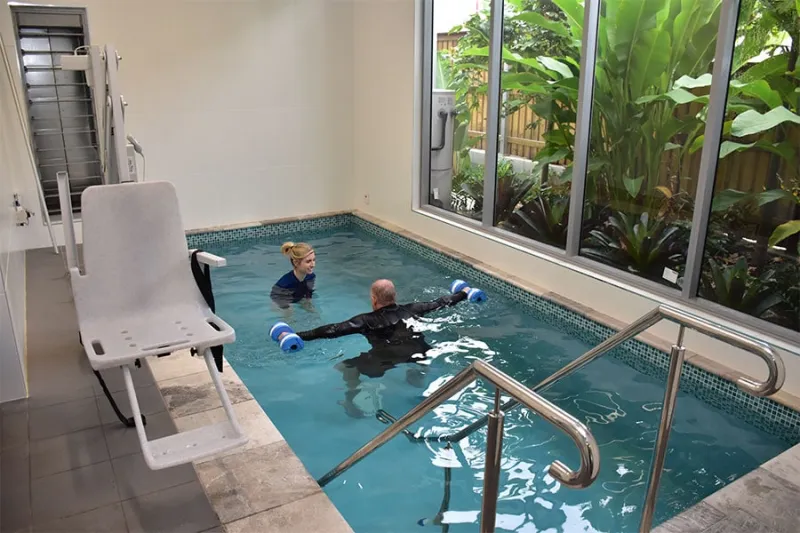
Sarah, a 44-year-old teacher from Portland with generalized anxiety disorder, had a similar trajectory. She discovered aquatic therapy after a shoulder injury sent her to a pool-based physical rehabilitation program. "The physical therapist kept commenting on how calm I seemed after sessions. I started paying attention and realized my anxiety was just... quieter on the days I was in the water."
She now visits a local hydrotherapy center twice a week and describes the practice as "non-negotiable" for her mental health maintenance.
The Conversation Psychiatry Hasn't Had Yet
Here's the honest truth: most American psychiatrists receive almost no training in somatic or hydrotherapy approaches. The field is medication-focused by training, by culture, and frankly by incentive structure. This isn't malicious — it's institutional. But it means that patients often aren't told about evidence-based alternatives or complements to medication simply because their doctors don't know to mention them.
The research on water immersion and anxiety is not fringe. It appears in peer-reviewed journals. It's being studied at major European universities. The gap isn't in the science — it's in the conversation.
A 20-Minute Protocol Worth Trying
If you want to explore this yourself, here's a simple starting point:
- Temperature: 94–98°F (warm but not hot — you should be comfortable for the full duration)
- Duration: 20 minutes minimum; 30–40 minutes for deeper nervous system effects
- Environment: Dim lighting, minimal noise, no phone
- Breathing: Slow, diaphragmatic breaths throughout — this amplifies the vagal stimulation
- Frequency: Three to four times per week for measurable cumulative effects
If you have access to a genuine mineral water pool — or can travel to a Bulgarian thermal spa where the water chemistry adds another layer of neurochemical benefit — the effects are compounded. But even a well-managed home bath is a legitimate starting point.
The anxious mind deserves more options. Warm water might be one of the most underrated ones we have.