The Silent Fire Inside: What Your CRP Score Reveals — and Why Thermal Bathing Addresses It Better Than Your Supplement Stack
You've probably heard that inflammation is bad. You've seen the turmeric supplements, the anti-inflammatory diet plans, the listicles about foods that "fight inflammation." But there's a specific, measurable marker of systemic inflammation that most wellness content — and honestly, most annual physicals — still don't prioritize. It's called C-reactive protein, or CRP. And the gap between how important it is and how rarely it gets discussed is genuinely striking.
More interesting still: while the supplement industry races to sell you the next inflammation-fighting compound, a centuries-old therapy practiced across Eastern Europe — specifically in Bulgaria's mineral thermal springs — appears to address CRP through mechanisms that no capsule can replicate.
What CRP Actually Is (and Why It Matters)
C-reactive protein is a substance your liver produces in response to inflammation. Think of it as your body's internal alarm signal. When tissues are under stress — from infection, injury, chronic disease, or sustained psychological pressure — CRP rises. It's measurable through a simple blood test, and the high-sensitivity version (hs-CRP) can detect even low-grade, chronic inflammation that wouldn't register on standard panels.
Research over the past two decades has connected elevated CRP to an impressive — and alarming — list of conditions: cardiovascular disease, type 2 diabetes, autoimmune disorders, depression, cognitive decline, and accelerated aging. A 2019 review in the Journal of the American College of Cardiology described hs-CRP as one of the strongest independent predictors of major cardiac events, sometimes outperforming LDL cholesterol as a risk indicator.
Yet the average American wellness routine — protein shakes, HIIT workouts, multivitamins — is largely designed around other metrics. CRP sits in the background, quietly tracking a fire that most people don't know is burning.
The Problem with the Supplement Approach
To be fair, certain compounds do have evidence behind them for reducing CRP. Omega-3 fatty acids, curcumin, and resveratrol all show modest effects in controlled studies. But "modest" is doing a lot of work in that sentence. The bioavailability of most over-the-counter anti-inflammatory supplements is notoriously inconsistent, and their effects on CRP tend to be small and dependent on dosage, formulation, and individual gut absorption.
More fundamentally, supplements address inflammation at the molecular level without necessarily addressing the systemic conditions that allow chronic inflammation to persist — things like autonomic nervous system dysregulation, poor sleep architecture, and sustained physiological stress responses.
Thermal bathing, by contrast, works at multiple levels simultaneously.
Heat-Shock Proteins: The Mechanism Most People Haven't Heard Of
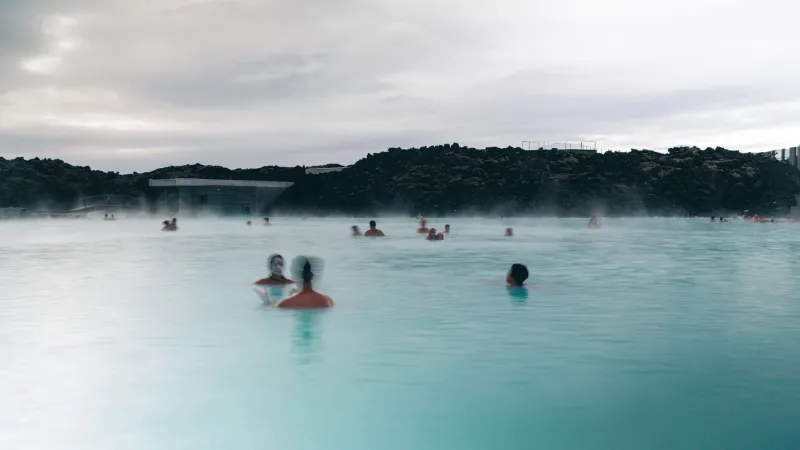
When your body is exposed to sustained, moderate heat — the kind you experience during full-body thermal water immersion — it produces a class of molecules called heat-shock proteins (HSPs). These are cellular stress-response proteins, and they play a surprisingly powerful role in inflammation regulation.
HSPs act as molecular chaperones, helping to refold damaged proteins and clear cellular debris that can trigger inflammatory cascades. They also interact directly with immune system signaling pathways, effectively dampening the overactive inflammatory responses that keep CRP elevated in people with chronic stress or metabolic dysfunction.
A 2018 study published in Experimental Physiology found that regular heat exposure through whole-body immersion increased circulating HSP70 levels and was associated with reduced markers of systemic inflammation over a six-week period. This isn't a fringe finding — the relationship between thermal stress, HSP induction, and inflammatory regulation is increasingly well-documented in exercise physiology and rehabilitation medicine literature.
And here's what makes thermal water immersion particularly effective compared to, say, a dry sauna: the water medium allows for longer, more sustained heat exposure at a consistent temperature, with the added benefit of hydrostatic pressure effects on the lymphatic and circulatory systems.
The Parasympathetic Connection
There's another pathway worth understanding: the nervous system.
Chronic inflammation and chronic stress are deeply intertwined. When your sympathetic nervous system — the "fight or flight" branch — stays activated over long periods, it maintains a low-grade inflammatory state throughout the body. Cortisol, the primary stress hormone, initially suppresses inflammation in acute situations but paradoxically promotes it when chronically elevated.
Thermal immersion is one of the most reliable non-pharmacological triggers of parasympathetic nervous system activation — the "rest and digest" state that counteracts chronic stress physiology. The combination of warmth, buoyancy, and sensory quietude during a thermal bath shifts the autonomic balance in a measurable way. Heart rate variability improves. Cortisol levels drop. And with that shift, the inflammatory signaling that cortisol was sustaining begins to quiet down.
This is why people who spend consistent time in thermal water don't just feel relaxed — they often report reductions in joint pain, skin inflammation, and digestive symptoms over time. These aren't placebo effects. They're downstream consequences of a nervous system that has been allowed to downregulate.
Why Bulgarian Mineral Composition Changes the Equation
This is where geography becomes physiology.
Bulgarian thermal springs carry a mineral profile that is functionally different from plain hot water or standard spa pools. The bicarbonate and sulfate content of many Bulgarian springs has been associated with enhanced skin permeability, allowing minerals to interact with subcutaneous tissues during immersion. Sulfur compounds, present in several Bulgarian spring sources, have demonstrated anti-inflammatory properties in dermatological and rheumatological research, with studies showing reductions in inflammatory cytokines following balneotherapy with sulfur-rich water.
Magnesium — present in meaningful concentrations in Bulgarian mineral water — is worth highlighting separately. Magnesium deficiency is associated with elevated CRP, and a significant portion of the US population is chronically low in this mineral. Transdermal magnesium uptake during extended immersion isn't as efficient as dietary intake, but in the context of a week-long thermal program with multiple daily soaks, the cumulative exposure may be clinically meaningful.
The combination of heat-shock protein activation, parasympathetic engagement, and mineral-assisted anti-inflammatory pathways creates a multi-pronged effect on systemic inflammation that no single supplement can replicate.
What This Looks Like in Practice
For Americans considering thermal therapy as part of an inflammation management strategy, the key variables appear to be frequency and duration. Single sessions produce measurable short-term effects, but the research on CRP reduction points toward sustained exposure — ideally daily immersion over a period of at least one to two weeks — for lasting changes in inflammatory markers.
Bulgarian thermal wellness centers typically structure programs around exactly this model: multiple daily sessions of 20–40 minutes, combined with rest periods and supportive therapies. Visitors who complete a full week-long program and have their CRP checked before and after often find the results more compelling than anything their supplement cabinet delivered.
Ask Your Doctor About This Number
Next time you're at your annual physical, ask for an hs-CRP test. It's inexpensive, it's covered by most insurance plans, and it will tell you something genuinely important about your inflammatory status that your cholesterol panel might be missing entirely.
And if the number comes back higher than you'd like — which it does for a surprising percentage of otherwise "healthy" Americans — consider that the solution might not live in a bottle. It might live in the warm, mineral-rich waters of a Bulgarian thermal spring.