Your Heart's Secret Gym Membership: What 20 Minutes in Warm Water Does to Your Blood Vessels
Photo: Australian National Maritime Museum on The Commons, No restrictions, via Wikimedia Commons
Here's a thought experiment: imagine a workout where your muscles stay relaxed, your joints feel weightless, and your heart still gets a legitimate training session. Sounds like wellness marketing nonsense, right? It isn't. It's basic fluid physics — and it's happening every single time you sink into warm water up to your chest.
Most Americans think of a hot soak as a luxury, a spa-day indulgence. Bulgarian spa towns have treated it as medicine for centuries. And emerging cardiovascular research is starting to catch up to what the grandmothers of Velingrad already knew: the water itself is doing the work.
The Pressure You Can't Feel (But Your Heart Can)
The magic ingredient is hydrostatic pressure. When you're submerged to the neck, water pushes inward on your body from every direction — roughly 1,000 times denser than air, doing its quiet work on your skin, your limbs, your organs. That gentle squeeze compresses the peripheral blood vessels in your legs and arms, which nudges blood back toward your core and your heart.
For your heart, this is the equivalent of going from a sedentary desk job to a light workout — without your legs ever moving. Central blood volume increases, stroke volume rises, and your cardiovascular system shifts into a mode that researchers sometimes describe as "passive exercise."
Why Warm Water Beats a Warm Room
Now add heat to the equation. Warm water — think the 37–42°C range we talk about constantly around here — triggers vasodilation, the widening of blood vessels near the skin. Your body responds to that heat by pushing blood outward to cool itself, increasing circulation to tissues that normally run on cruise control.
Put those two forces together — inward compression plus heat-driven dilation — and you get a vascular pump effect. Vessels open and close, blood flows more freely, and arterial walls get a gentle, repetitive stretch that some researchers compare to a slow-motion vascular workout. Studies on regular thermal bathers in Japan and Finland have linked frequent warm-water bathing to lower rates of hypertension and improved vascular function. The mechanism isn't mysterious; it's hemodynamics.
The Slow-Release Advantage
Unlike a HIIT session or a cold plunge, which spike your system and demand recovery, warm immersion works like a time-release capsule. Blood pressure typically eases down over the course of a soak and stays softened for hours afterward. Your resting heart rate drops. Your breathing deepens without you asking it to.
For the millions of Americans managing elevated blood pressure — or just worried about where their numbers are trending — that's a meaningful tool. We're not suggesting you cancel your cardiologist or toss your medication (please don't). We're suggesting that a 20-minute warm soak, done regularly, is one of the lowest-effort cardiovascular habits available to a human being.
What a "Vascular Soak" Actually Looks Like
Want to turn your next thermal session into a heart-smart ritual? Here's the simple protocol we recommend to guests at our Bulgarian springs:
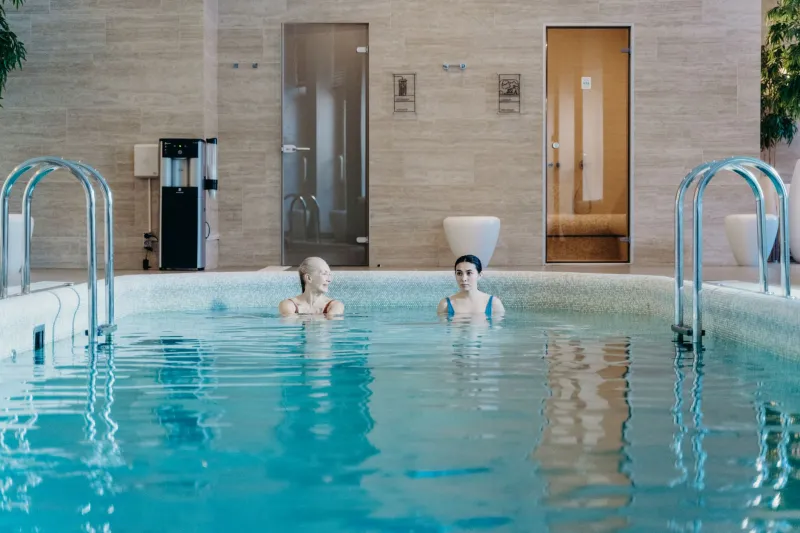
- Get in deep. Chest-level immersion is where the hydrostatic pressure really kicks in. Sitting in shallow water is pleasant; it just doesn't deliver the same circulatory load.
- Stay 20–30 minutes. Shorter sessions warm the skin; longer ones reach the circulation. Exit earlier if you feel lightheaded — hydration matters.
- Repeat, don't binge. Like exercise, the benefits are cumulative. Three to four soaks a week beats one marathon session a month.
- Breathe slowly. Deep, steady breathing amplifies the parasympathetic shift, which supports blood pressure regulation on its own.
The Bulgarian Bonus
There's one more variable that's hard to replicate in a bathtub at home: the water itself. Bulgaria's thermal springs carry a dense mineral load — calcium, magnesium, bicarbonates — absorbed through the skin during long immersion. Magnesium in particular plays a documented role in vascular tone and blood pressure regulation.
So when you sink into a mountain-fed thermal pool in Velingrad or Hissarya, you're getting a triple intervention: hydrostatic pressure, therapeutic heat, and bioavailable minerals. Your heart, meanwhile, is quietly doing laps without you.
Twenty minutes. No laces, no gym bag, no sweat. Just you, the water, and a cardiovascular system getting the gentlest workout of its life. Honestly, there are worse ways to invest in your arteries.